On this page
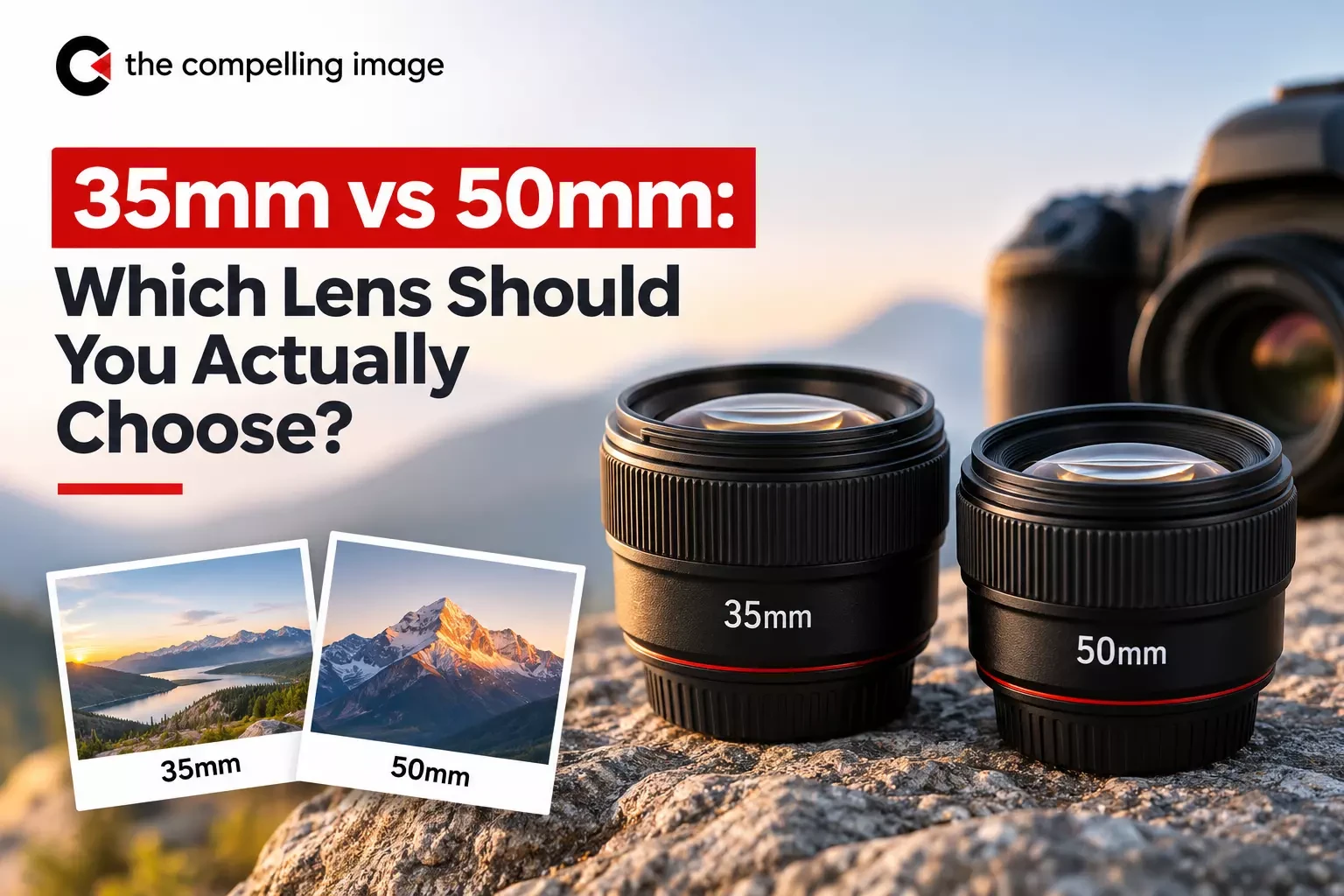
If you want the short answer to the 35mm vs 50mm question, then a 35mm is generally the better lens for street, travel, indoor work, and people in their environment, and a 50mm is the better lens for portraits, detail, and picking out one subject in a busy scene. On a full-frame camera, the 35mm will cover around 63 degrees of the scene and the 50mm around 47.
The bigger difference really (and the one that most of the comparisons seem to overlook) is where each lens puts you.
What's the real difference between a 35mm and a 50mm?
Both are prime lenses. The difference is in the amount of scene they show.
- The 35mm is a bit wider. It'll get a person and a good bit of the room/street around them in the frame without you having to step back.
- The 50mm is frequently referred to as a 'normal' lens. On a full-frame camera, it's showing you a scene at the size and spacing you'd expect if you were actually there. Our guide to the 50mm lens looks at just where that 'normal' comes from.
People also ask which of the two is closer to the human eye, and there's no clean answer. Our eyes don't have a single fixed field of view the way a lens does. The 50mm is known as 'normal' because its focal length is approximately the diagonal of a full-frame sensor (around 43mm), so it's really just a convention rather than anything to do with the human eye.
Which one you actually need is going to be down to what you're photographing and down to how comfortable you are getting up close to people
Where will you be with each lens?
Here are some approximate working distances (not set in stone) for a full-frame camera with a bit of space around the subject. The first figure is with the camera held upright (portrait), the second with it held level (landscape).
|
Head and shoulders |
about 0.6 m / 0.9 m |
about 0.8 m / 1.25 m |
|
Waist up |
about 1 m / 1.5 m |
about 1.4 m / 2 m |
|
Full figure |
about 2 m / 3 m |
about 2.8 m / 4.2 m |
|
Three people side by side (camera level) |
about 1.8 m |
about 2.5 m |
A few things do stand out.
- With a 35mm you're quite literally in someone's personal space for a head and shoulders shot.
- With the 50mm you're at normal talking distance for the same framing.
- For a group of three in a small living room, the extra 70cm or so that the 50mm requires is often more than the room has.
Does a 50mm actually compress the background?
You'll read that one again and again, along with the idea of the 35mm lens 'distorting faces'. Neither of those is actually down to the lens at all. Perspective (the way the background is sized in relation to the subject, the way a face is 'shaped') is all to do with how far away the camera is from the subject. Focal length has nothing to do with the perspective of a face; it only determines how much of the scene you see in the frame.
You can easily verify this for yourself in about 5 minutes.
- Just stand in one place and take a shot of the same scene with both lenses.
- Then crop the 35mm image down to match the frame of the 50mm.
- Apart from a minor loss of resolution, the two images will be virtually identical.
The difference in practice is that to fill the frame with the same subject you have to get a lot closer on the 35mm, and it's that proximity which makes the nose look so much bigger in a tight portrait and the background look so much smaller and further away. The guide to perspective in photography has more on the fact that it's all down to position rather than focal length.
If you're after a softer, more 'separated' background in your portraits, then the 50mm makes that easier, just because it puts you a bit further back for the same framing.
35mm vs 50mm for street photography
- The 35mm will allow you to include a person and the context around them. You do have to get close to people in order for them to count in the frame, though.
- The 50mm enables you to work from a couple of meters back and pick out a single gesture or a single face from a sea of people on the pavement.
If someone is sitting at a café table by a window, then on a 35mm you'd be a step or two away, and you could get them, the cup and the street outside in the same frame. On a 50mm you could be right at the next table and just frame them and the cup.
Henri Cartier-Bresson mainly used a 50mm on his Leica. Richard Kalvar of Magnum says in an interview published by the agency that he uses a 35mm for his personal work. If you're just getting into it, our beginner's guide to street photography will cover the settings as well as the nerves aspect.
35mm vs 50mm for portraits
If it's just a straightforward portrait, where the person is pretty much the whole picture, the 50mm tends to be the easier lens to get on with. For a head-and-shoulders shot it'll have you standing about 0.8m away (rather than the 0.6m or so you'd need on a 35mm) and it's really that bit of extra distance that stops the nose and chin from looking exaggerated.
An environmental portrait is different, as the place is part of the story. For a baker in her kitchen or a mechanic in his workshop, the 35mm is the lens to use, as it will get the person and enough of their environment in from a normal working distance.
What you want to avoid with a 35mm is very tight headshots. Our portrait photography techniques guide has more on lighting and posing.
35mm vs 50mm for Travel, Indoors and Groups
For travel, the 35mm is probably the more useful single lens, largely down to the fact that so much of travel photography is in situations where you can't step back.
If you find even the 35mm a bit tight for indoors then that's usually a good sign you need something properly wide, and the guide to wide-angle photography goes into what changes once you go below 35mm.
Where the 50mm really comes into its own is in terms of detail. It's just as good in low light (both lenses are readily available in f/1.8, and that's about three stops brighter than a typical f/5.6 kit zoom at its long end).
What if your camera has a crop sensor?
The focal length printed on the lens doesn't change at all when you put it on a different camera. What changes is the field of view, as the crop sensor only records the central portion of the image the lens projects. To compare, people will refer to the 'equivalent' focal length, which is simply the actual focal length multiplied by the crop factor.
|
Canon APS-C |
1.6x |
about 56mm |
about 80mm |
about 22mm |
about 31mm |
|
Nikon, Sony, Fujifilm APS-C |
1.5x |
about 52mm |
about 75mm |
about 23mm |
about 33mm |
|
Micro Four Thirds |
2x |
about 70mm |
about 100mm |
about 17.5mm |
25mm |
If you're on a Nikon, Sony, or Fujifilm APS-C body (1.5x) and someone says "get a 35mm for street," the lens that actually gives you the view they mean is around 23mm. On APS-C, a 35mm gives you pretty much the classic 50mm view, and a 50mm becomes a short portrait lens.
Which lens is the one that corresponds to the way you see?
- Some people like to be right in the thick of it, the picture being as much a picture of where they were as it is of who they were looking at.
- Others would rather be a bit further back, a little more removed, and just pick one thing out of the whole scene.
The first group usually becomes the 35mm lot and the second the 50mm lot.
If you're still not sure which you are, then just go back through some of the photos you already like and see whether you're the type to keep coming back to the wide, busy ones or the tight, simple ones. That's part of what people mean by developing a photographic voice.
35mm or 50mm: Which Should You Buy First?
- Go for the 35mm if most of what you're shooting is street, travel, family life indoors, people in their environment, or if you're on full frame and want one lens that does most things.
- Go for the 50mm if you're mainly shooting people individually, if you like detail and simple compositions, or simply prefer to work a bit further back.
If you're still not sure and you're on full frame, then start with the 35mm. It covers more of the scenarios mentioned above.
Whatever lens you end up with, just put the zoom away and use that lens for a month. If you'd like to do that month with a bit of structure, then Beyond the Click is our 30-day online course, which has assignments and feedback on your own pictures throughout.
FAQs
Is a 35mm or a 50mm better for beginners?
For most beginners the 35mm is probably the easier one to live with as it fits more in from where you're actually standing (rooms, streets, family stuff at home etc). If you're primarily shooting one person at a time though the 50mm is going to feel a lot more natural very quickly.
Can you use a 35mm lens for portraits?
You can and it's absolutely great for environmental portraiture where the location is as important as the subject. Just don't get in too close for tight headshots as from around 0.6m the nose and chin start to look a bit exaggerated. Keep people well away from the corners of the frame.
Is a 50mm too tight for street photography?
Not at all, loads of people shoot street on a 50mm. You're working from a couple of meters back and you're just picking out faces and gestures so you're going to get less of the scene around them. If you're a bit nervous about getting up close to strangers that can be an advantage in that respect.
Which is better for low light, 35mm or 50mm?
There's not really any difference between them when you're looking at the same aperture. Both are commonly sold as f/1.8 lenses and that's about three stops brighter than a standard kit zoom at f/5.6 so either one is a massive improvement in the dark or indoors.
Do I need both a 35mm and a 50mm?
Not to begin with. Get the one that best suits the type of photography you do, use it on its own for a month or so and you'll very quickly find out whether you actually do miss the other one (loads of people don't).