On this page
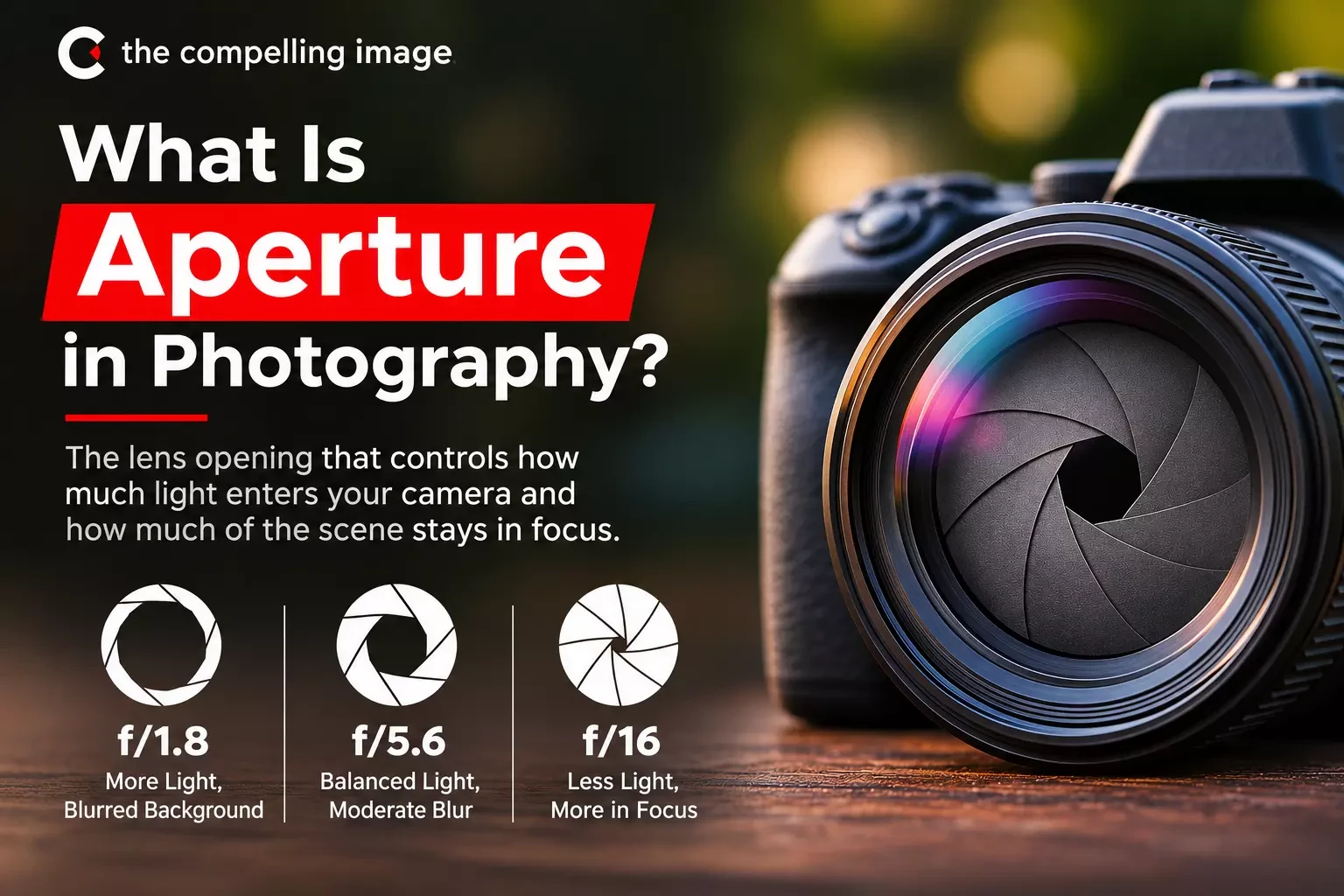
Aperture is the opening inside your lens that controls how much light reaches the sensor. It is measured in f-stops — f/1.8, f/5.6, f/11 — and it affects two things at once: exposure and depth of field. A wider aperture lets in more light and blurs the background. A narrower one lets in less light and keeps more of the scene sharp.
The number on your lens doesn't make much intuitive sense the first time you see it. f/1.8 lets in more light than f/16. A smaller f-number means a larger opening. The scale runs backward from what you'd expect — this article explains exactly why, and what it means for your photography.
In this article:
- What aperture is and how it works inside the lens
- Why the f-stop scale seems backward — and the simple reason behind it
- How aperture affects exposure and depth of field
- Which aperture to use for portraits, landscapes, and street photography
- How to practice and build a feel for it
The aperture mechanism: blades, light, and focus
Your lens has a set of overlapping blades near the middle — the diaphragm. When you set an aperture, you're adjusting how wide those blades open, which controls the size of the hole that light passes through on its way to the sensor.
A wide aperture (f/1.8, f/2.8) means the blades are mostly open. A narrow aperture (f/11, f/16) means the blades close down to a small circle. That hole size does two things simultaneously: it changes how much light reaches the sensor, and it changes how much of the scene appears in sharp focus.
Why a smaller number means a bigger opening
The f-stop number is a ratio — the lens focal length divided by the diameter of the entrance pupil (the apparent size of the aperture opening as seen from the front of the lens). f/4 on a 100mm lens means the entrance pupil appears 25mm across. f/16 on the same lens means it's about 6mm across.
This is why f/1.4 is a "wide" aperture, and f/16 is a "narrow" one, even though 16 is the bigger number. Once you understand it's a fraction, the scale makes sense. Just know that lower numbers mean more light; higher numbers mean less.
Each full f-stop doubles or halves the amount of light. f/2.8 lets in twice as much light as f/4, and half as much as f/2. This doubling relationship runs through all three exposure controls — aperture, shutter speed, and ISO — which is what makes the exposure triangle work as a system.
Aperture, shutter speed, and ISO: how they connect
Aperture is one of three controls you have over exposure. The other two are shutter speed (how long the shutter stays open) and ISO (which controls how much the sensor's signal is amplified — higher ISO brightens the image but also amplifies noise). Change one, and you generally need to adjust one of the others to maintain the same overall brightness.
Open up from f/5.6 to f/4, and more light hits the sensor — now your shutter speed or ISO needs to shift to balance it out. That back-and-forth between three controls is exactly how the exposure triangle works. Once you feel it in practice, the decisions stop feeling like guesswork.
Depth of field: what stays sharp and what doesn’t
The second effect of aperture is depth of field — how much of the scene, front to back, appears sharp in the final image.
A wide aperture (f/1.8, f/2) produces shallow depth of field. Objects close to your focus point are sharp; things in front of and behind them blur. This is the background blur — called bokeh — that portrait photographers often use to separate a subject from a distracting background.
A narrow aperture (f/11, f/16) produces deep depth of field. More of the scene, from near to far, stays acceptably sharp. This is generally what landscape photographers want — a foreground stone and a distant mountain peak both in focus at the same time.
Same aperture, very different blur — that's what distance does. A 50mm at f/2.8 from two meters blurs heavily; pull back to ten meters, and it mostly disappears. Depth of field is a product of three things working together, not aperture alone.
Choosing the right aperture for portraits, landscapes, and street
There's no universal answer, but there are useful starting points.
For portraits: f/1.8–f/2.8 for a single subject where you want background separation. Go slightly narrower — f/3.5 to f/5.6 — when shooting two or more people side by side. At f/1.8, the depth of field is thin enough that one person's nose can be sharp while their ears go soft.
For street photography: f/5.6–f/8 is a common working range. It gives enough depth of field that you're not constantly missing focus in fast-moving situations, and keeps most of the scene readable.
For landscapes: f/8–f/11 covers most situations. Closing down further doesn't always improve sharpness. At very narrow apertures, diffraction causes light to spread slightly, reducing fine detail across the frame. Many lenses produce their sharpest results in the middle of their aperture range.
For general use: f/5.6–f/8 works on most lenses, most of the time. Sharp enough, enough depth of field, enough light — without pushing too far in any direction.
Situations where changing aperture makes things worse
New photographers often reach for aperture first because the background blur is the most visible side effect. But there are situations where changing aperture creates problems.
Opening up gives you light — but it also shrinks your focus window. On a moving subject, that's a problem. One missed focus at f/1.8, and the shot is gone; at f/8 you'd have kept it. Sometimes raising ISO or slowing the shutter is the smarter call. Same goes for groups or architecture — open up too wide and the edges of the frame go soft before you notice.
What your lens’s maximum aperture actually means
Pick up a 50mm f/1.8 and a kit lens. Take both into a dim cafe at the same settings. The f/1.8 gives you a usable shot; the kit lens gives you grain. That gap — over nine stops of light between f/1.8 and f/5.6 at its widest — is why photographers spend money on faster glass.
Shooting on APS-C? The crop factor — typically 1.5x or 1.6x — means a 50mm lens gives an angle of view closer to 75–80mm on full-frame. The maximum aperture stays the same, but the smaller sensor captures a narrower field of view. On APS-C, a 35mm lens gets you closer to the standard 50mm framing.
Try this before your next shoot
Pick a subject with something behind it and shoot it from a tripod at f/2, f/5.6, and f/11 — nothing else changes except shutter speed or ISO to hold the exposure. The background blur is the first thing you notice. The second is how unforgiving f/2 actually is. A subject that shifts a few centimeters forward can lose focus entirely — something you'd never see at f/8.
Camera settings for ISO, shutter speed, and aperture cover all three together when you're ready to work through them as a system. Get comfortable with aperture first, then bring the other two in — the logic connects quickly once you've felt each one separately.
For a more structured path through all three, Beyond the Click builds from the ground up — exposure, seeing, and making deliberate decisions at the camera.
FAQ
What does the f-stop number mean?
The f-stop is a ratio of the lens focal length to the diameter of the entrance pupil. A lower number (f/1.8) means a wider apparent opening and more light. A higher number (f/16) means a smaller opening and less light. Each full stop doubles or halves the amount of light entering the lens.
What aperture is best for portraits?
f/1.8–f/2.8 for a single subject where you want background blur. f/3.5–f/5.6 when shooting two or more people — at f/1.8 the depth of field is shallow enough that one person can be sharp while another goes slightly soft.
What aperture is best for landscapes?
f/8–f/11 covers most situations. Going narrower can reduce sharpness due to diffraction — many lenses produce their sharpest results in the middle of their aperture range.
What is aperture priority mode?
Set the aperture, let the camera worry about shutter speed — that's aperture priority, A or Av on the dial. It holds up well in controlled light. Where it gets you is unpredictable light or a moving subject; the camera compensates for brightness, not for motion blur.