
On this page
Arnold Newman made his portrait of Igor Stravinsky in 1946. Harper's Bazaar had commissioned it — and then rejected it. The art director Alexey Brodovitch reportedly felt it was too good to be printed small in a magazine. The photograph became Newman's most celebrated work: Stravinsky seated at a grand piano, the piano's open lid dominating the frame, its shape imitating the flat symbol in musical notation. The composer occupies a corner of his own portrait. The instrument — his life's work — takes most of the space. That's what an environmental portrait does at its best. The surroundings don't decorate the subject. They explain them.
What separates environmental portraiture from other portrait work
In a studio portrait, the background is simple — it removes context deliberately, focusing attention entirely on the face. In an environmental portrait, the background is informational. It tells the viewer something they couldn't learn from the face alone: what the person does, where they spend their time, what their world looks like.
Newman described his approach as "a preoccupation with abstraction, combined with an interest in the documentation of people in their natural surroundings." In practice, that meant placing subjects in their studios, offices, workshops, and homes — and then composing the frame so that the relationship between person and environment carried meaning. Jackson Pollock in his studio. Arthur Miller backstage at a theatre. In each case, the environment isn't incidental. It's the argument the photograph is making.
The genre sits at the intersection of portraiture, documentary photography, and editorial work. You're working with real spaces that have their own character and constraints, and learning to use those constraints rather than fight them is the central skill.
Location is the first decision — not the last.
Most portrait photographers choose a location and then figure out what to do with it. Environmental portraiture inverts that. The location should be chosen because it says a precise point regarding the subject — their workplace, a space they've shaped over years, somewhere the evidence of how they spend their time is visible in every corner.
A workshop where someone has worked for thirty years looks different from one they've used for six months. The tools have been positioned and repositioned until they're exactly where they need to be. The walls have marks on them. The light coming in through a particular window at a particular hour is something the person knows from habit. All of that is available to the camera, but only if you're paying attention to it.
Walk the space before you set up. Notice what's been worn, what's been arranged, what the person moves past without noticing because they stopped seeing it years ago. These are the details that carry the portrait's weight — a single well-chosen element in the frame often does more than a dozen arranged props.
The question to persist in asking is: does this location tell the viewer something about this person that the face alone wouldn't? If the answer is no, the location is wrong, or you haven't found the right angle in it yet.
How to balance subject and environment in the frame
The central compositional challenge in environmental portraiture is keeping the subject as the clear focal point while giving the environment meaningful space. Get this wrong in one direction, and you have a portrait with a busy background. Get it wrong in the other, and you have an environmental photograph with a person in it.
Newman's Stravinsky portrait manages this through scale and geometry. The piano is enormous in the frame — far larger than the composer — but Stravinsky's position and gaze hold the eye. The environment has weight, but the person has presence. Neither overwhelms the other.
In practice, this proportion comes from placement and depth of field working together. Positioning the subject so they interact with — rather than simply stand in front of — the environment creates a visual connection between them. Shooting at f/5.6 or f/8 rather than wide open keeps enough of the environment sharp that it reads as intentional context, not blurred background. A chef photographed at f/1.8 in their kitchen could be in any kitchen. At f/5.6, the specific chaos of that particular kitchen comes through.
Compositional decisions about depth, layering, and the relationship between foreground and background matter here exactly as they do in any other photographic situation — the difference is that in environmental work, the background is part of the subject, not something to be managed or minimized.
Working with available light in real spaces
Real spaces have real light — windows in positions you didn't choose, overhead fixtures with color temperatures that mix poorly, shadows in inconvenient places. The instinct is to bring artificial light and take control. The result is usually photographs that look lit rather than inhabited.
Available light in a working environment carries information. A north-facing window in a painter's studio has been there for a reason — it gives consistent, non-directional light that doesn't shift throughout the day. A single overhead lamp in a workshop produces the kind of hard, directional light the person has been working under for years. Using that light rather than replacing it keeps the photograph in the same visual world as the person's actual experience of the space.
This doesn't mean never introducing light — it means starting with what's there and adding only what's necessary. A small reflector to open shadows on one side of a face, a window to redirect, a single continuous light which corresponds to the color temperature of the existing sources. The test is whether additional light looks like it belongs in the space. If it doesn't, it probably shouldn't be there.
Understanding how light behaves in real situations — how it falls, how it wraps, how it interacts with different surfaces — is what allows you to use available light as an asset rather than work around it as a limitation.
Directing the subject
Environmental portraits can be either candid — the person photographed doing what they actually do — or directed, where you ask them to interact with the space in a particular way. Both approaches work. The distinction matters less than whether the subject looks like they belong there.
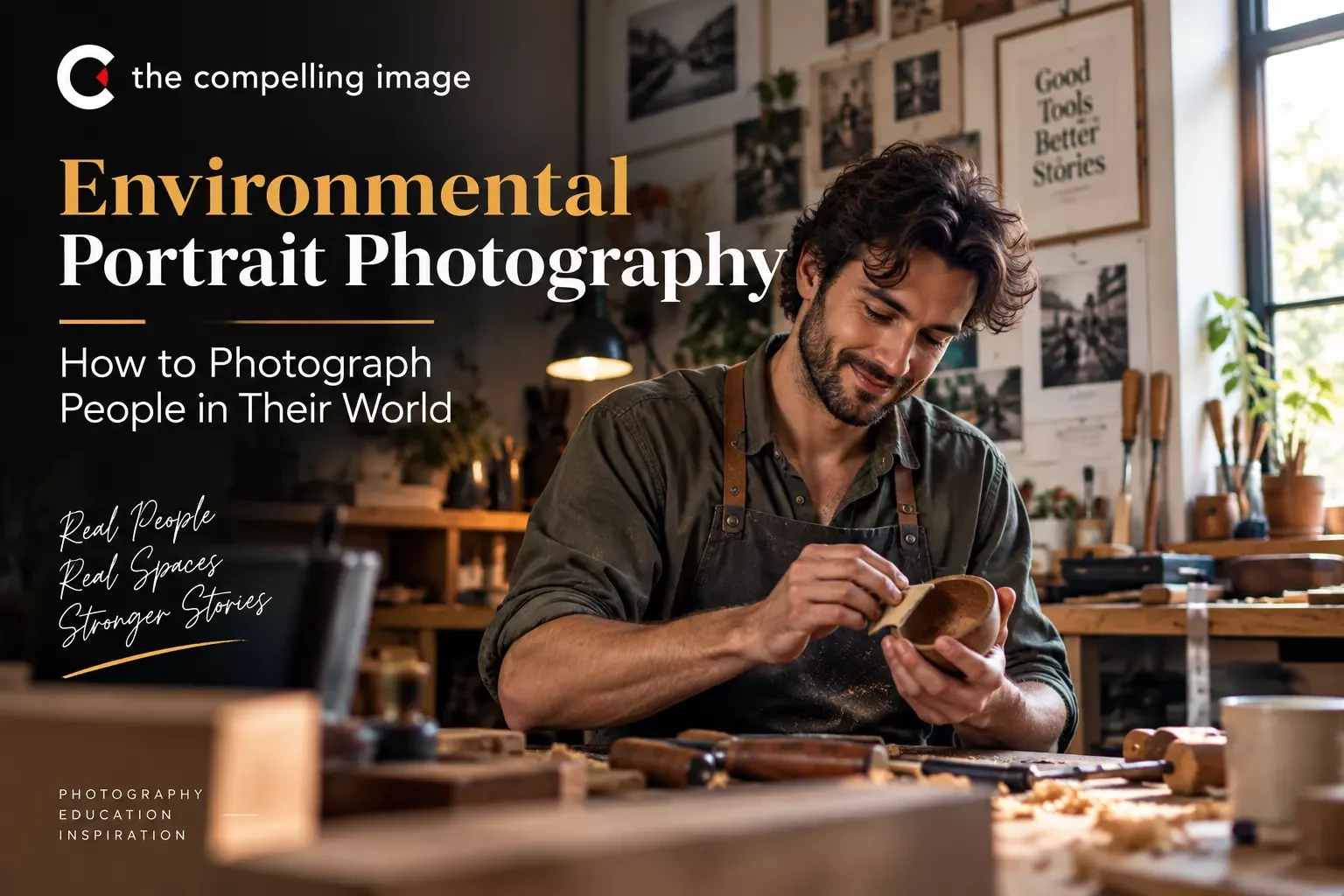
People who are uncomfortable in front of a camera tend to forget about the camera when they have something to do. Asking someone to demonstrate how they do a specific task — a woodworker making a cut, a baker shaping dough, a musician tuning an instrument — occupies their attention in a way that makes self-consciousness difficult to maintain. The resulting images often feel more natural than any amount of "just relax" direction produces.
The framing of how you give direction affects the effect significantly. "Stand there and look at me" produces a different result from "show me what you'd be doing at this time of day." The first produces a posed portrait. The second produces a portrait of someone doing something — which is a different kind of image with a different kind of energy.
Spend time in the space before you start shooting. Talk about the work, the space, the history of things in it. By the time the camera comes up, the person has been reminded of who they actually are in this environment, rather than who they think they should be in a photograph.
The difference between context and clutter
Not everything in a real space earns its place in the frame. A workshop has decades of accumulation — tools that haven't been used in years, objects that mean nothing to the person photographed or to anyone viewing the image. The job is to read what's significant and what isn't, and compose accordingly.
Newman made this distinction deliberately. His portraits include the elements that reveal — the piano lid's shape, the studio's particular disorder, the office's symbolic objects — and exclude what would just read as background noise. This requires editing the frame through composition: angle, focal length, and depth of field all affect which elements of a space appear and how much weight they carry.
A longer focal length — 85mm, 105mm — compresses the relationship between subject and background, pulling environmental elements closer to the person. A wider focal length — 35mm, 28mm — exaggerates the space around the subject and accentuates the scale of the environment. Neither is more correct. Each produces a different reading of the relationship between person and place.
Developing a sustained photographic practice with a specific subject — returning to photograph the same person over time, in the same space — produces environmental portraits that accumulate meaning across the series, showing how a person and their environment change in relation to each other.
What environmental portraiture teaches
Working in real spaces with real people requires a different kind of attention from studio photography. You can't control everything. The light is what the light is. The space has its own logic. The person has their own habits and relationship with the environment that you're trying to understand rather than replace.
That constraint produces better photographs, more often, than full control does. Newman's Stravinsky portrait works precisely because the piano is actually Stravinsky's — or at least one exactly like the pianos he worked with. The scale relationship between composer and instrument is real, not constructed. The image carries that reality.
If you want to develop the visual thinking that environmental portraiture requires — reading a space, reading a person's relationship to it, making compositional decisions under real conditions — Fearless Faces covers photographing people in real situations, moving from the discomfort of pointing a camera at a stranger toward images that feel genuine rather than performed.
FAQs — Environmental Portrait Photography
What is an environmental portrait?
A photograph of a person in a space that tells the viewer something about them — their work, their habits, their world. The environment isn't background. It's part of the subject.
What's the difference between an environmental portrait and a regular portrait?
In a studio portrait, the background is simple or decorative. In an environmental portrait, the background is informational. It offers context that the face alone can't provide.
What locations work best for environmental portraits?
Wherever the person actually spends their time — a workshop, kitchen, studio, office, garden. The best locations show evidence of use: wear, arrangement, accumulated objects. A space the person has shaped over years tells a different story from one they've borrowed for a shoot.
What aperture should I use for environmental portraits?
f/5.6 to f/8 for most situations. Wide enough to keep the subject sharp, narrow enough that the environment reads as intentional context rather than blurred background. At f/1.8, the surroundings disappear — which defeats the purpose.
Do I need professional lighting for environmental portraits?
No. Available light in a real space carries information about how the person actually works and lives. Start with what's there. Add light only when necessary, and only if it looks like it belongs in the space.
How do I direct someone who's uncomfortable in front of a camera?
Give them something to do rather than something to be. Ask them to demonstrate a task, show you how something works, or do what they'd normally be doing at that time of day. Occupation reduces self-consciousness in a way that reassurance rarely does.
How do I balance the subject and environment in the frame?
The subject should be the clear focal point — the viewer should know immediately who the image is about. The environment gets meaningful space but doesn't compete. Position, depth of field, and the subject's gaze all help sustain that hierarchy.