
On this page
The window is short. Roughly 20 to 40 minutes after sunrise or before sunset — less in summer at higher latitudes, sometimes longer in winter near the poles. Most photographers who talk about shooting at golden hour mean they were outside during that window. The ones who make the strongest work during it were outside before it started.
That's the first thing that separates golden hour photographs that look deliberate from ones that look lucky: preparation. The light doesn't wait for you to find your position.
How the light behaves at golden hour
The sun at low angles produces light that travels through more atmosphere than it does at midday. That longer path scatters the shorter blue wavelengths and lets the longer red and orange ones through — which is why the light turns warm. It also means the light source itself is effectively larger relative to the scene, which produces softer shadows than the intense midday sun directly overhead.
The light changes in three ways that matter:
Direction. Low sun means side-lighting rather than overhead light. Side-lighting reveals texture — every surface variation on a stone wall, the depth in a face, the relief in a building facade. The same wall at noon looks flat. At golden hour it doesn't.
Quality. Softer and more diffused than midday. Shadows stretch long but lose their hard edges. Highlights are bright without blowing out as readily. The scene's contrast range narrows — the sensor can hold both ends of it without sacrificing one for the other.
Color temperature. Warm — typically around 3,000–4,000 Kelvin, compared to roughly 5,500K at midday. This affects everything in the frame: skin tones read warmer, greens shift toward yellow-green, blues become less prominent.
Ernst Haas, the Austrian photographer whose color work appeared in Life magazine from the 1950s onwards and whose prints are held in the Metropolitan Museum of Art in New York, worked extensively with available light at these transitional hours. He described color not as a property of objects but as a property of light — and his golden hour work demonstrates what he meant. The same street, the same buildings, the same people: completely different photographs depending on the hour.
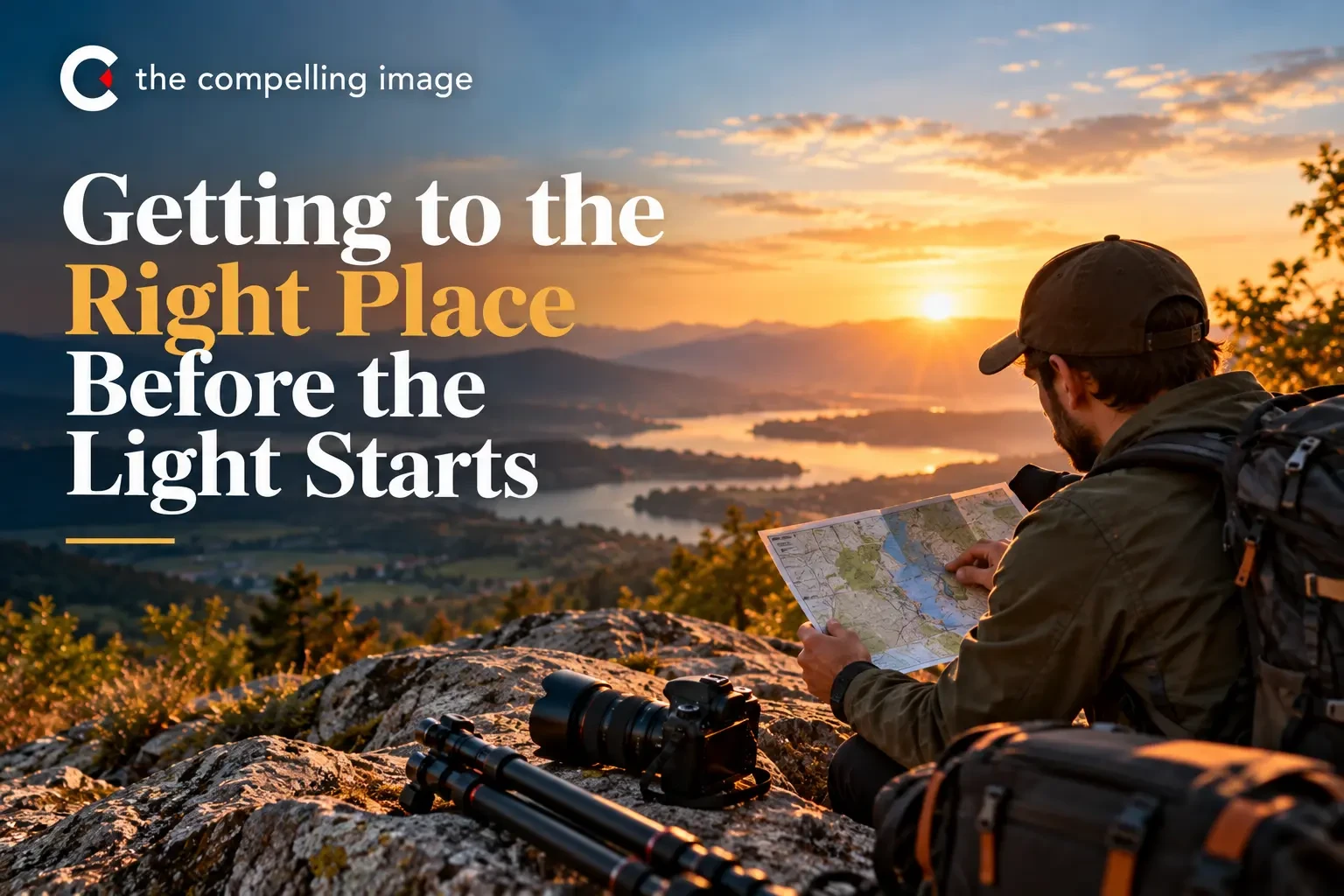
 Getting to the right place before the light starts
The most useful tool for golden hour photography is a sun tracking app — PhotoPills, The Photographer's Ephemeris, or even the basic sun direction apps available for free. These show you where the sun will rise or set from any location, on any date, along with the exact timing of golden hour and blue hour.
This matters because golden hour light is directional, and direction determines which subjects it suits. A valley that faces east gets golden hour light at sunrise but is in shadow at sunset. A west-facing cliff face is flat and dull at sunrise but lit dramatically at sunset. Knowing this before you arrive — not after you get there and find the light isn't what you expected — is what makes the difference.
Get there 30 minutes early. Find the composition, confirm the exposure, settle in. Once golden hour starts, the light moves fast — the strongest five minutes can be over before you've finished adjusting the tripod head.
Settings for conditions that won't stay still
Golden hour doesn't require unusual settings — it requires appropriate ones for the specific conditions, which change quickly.
ISO: Start at base ISO (100 or 200) when the light is still reasonable. When the sun drops toward the horizon and the light dims, raise it incrementally. The warm quality of the light means that a small amount of grain rarely looks wrong in golden hour images — it reads as atmosphere rather than noise.
Aperture: Depends on the subject. For landscapes where depth of field matters, f/8 to f/11. For portraits where you want the background to separate from the subject, f/2.8 to f/4 — wide enough to create separation without losing the radiance of the background light entirely.
Shutter speed: Watch this as the light drops. At the end of golden hour, you can lose several stops of light in a few minutes. A shutter speed that worked five minutes ago may now be too slow to handhold cleanly. Either raise the ISO, open the aperture, or use a tripod — which is worth having available regardless.
White balance: Auto white balance often tries to neutralize the warm tones of golden hour — the camera reads the warmth as a colour cast and corrects for it, producing a more neutral result than the actual light. Set white balance manually to Daylight (around 5,500K) or Cloudy (around 6,500K) to preserve the warmth of the image, or shoot RAW and decide in post. The exposure triangle and white balance together determine whether the final image looks like it was made at golden hour or like it was made at noon with a filter.
Subjects that golden hour transforms
Golden hour suits some subjects more than others, and understanding which is more useful than a list of locations.
Textured surfaces — stone walls, sand dunes, tree bark, old buildings — are transformed by low-angle side-lighting. The raking light reveals surface variation that overhead light obscures. If you photograph texture at any other time and wonder why it looks flat, this is why.
Portraits benefit from golden hour light because the warmth is flattering on skin tones and the softness reduces the harsh shadows that midday sun creates under eyebrows and chins. Backlighting — placing the subject between you and the sun — creates rim light that separates them from the background and produces the characteristic golden glow around the edges of hair and shoulders. You'll need to expose for the face rather than the bright background, either by spot metering on the skin or by adding fill with a reflector.
Landscapes change character entirely. The extended shadows create depth and dimension across flat terrain that would read as two-dimensional in overhead light. Water picks up the warm color of the sky. The color temperature gradient across a golden hour sky — warm near the horizon, shifting through orange to pink toward blue higher up — gives landscape photographers a tonal range that compresses into something photographs can hold.
Architecture in cityscapes responds well to golden hour because the low light angle creates shadow patterns throughout facades that reveal the three-dimensionality of buildings. Streets that run east-west catch the light differently from streets that run north-south. Walking a city during golden hour for the first time and noting which views work — so you know where to return — is a useful exercise in itself.
Street and documentary work at golden hour produces a different kind of image from landscape or portrait photography. The light is the same, but the subject is moving and unpredictable. The warm, directional light creates pools of illumination between shadows — a person walking through one of those pools, caught in the light for a second before moving back into shadow, is a different kind of golden hour photograph from a sunset landscape. It requires the same preparation — being in position before the light peaks — but different timing instincts.
Markets, busy streets, transport hubs — anywhere people are moving through in the early morning or early evening works. The low sun angle creates lengthy shadows that stretch across the frame and can be used compositionally. Two people in conversation, their shadows extending toward the camera at three times their actual length, is a photograph that only exists at this hour.
What happens when the warm light fades
Blue hour follows golden hour and is often overlooked by photographers who pack up when the warm light fades. The 20 to 40 minutes after sunset (or before sunrise) when the sky takes on a deep blue cast is a different kind of light, not a lesser one.
The quality changes: blue hour light is cooler, softer, and more even than golden hour. Artificial lights — street lamps, illuminated windows, vehicle headlights — start to appear in the scene and create a balance with the remaining natural light that's unique to this window. Lit buildings and urban scenes at blue hour often produce stronger images than at any other time of day, because the contrast between the lit elements and the sky is manageable rather than extreme.
The technical approach at blue hour shifts slightly. ISO needs to go up — the light is significantly dimmer — and a tripod becomes necessary for anything that isn't handheld street work. Set white balance manually to Tungsten or a custom setting around 3,200K to retain the blue cast, or shoot RAW and decide in post.
The exposure challenge at blue hour is mixed light sources. A building's interior lights are warm; the sky is cool blue; the street lamps are somewhere between the two. Bracketing exposures — shooting the same composition at several different shutter speeds — gives you options in post that a single exposure won't. For architecture and urban scenes, this is the standard approach.
What blue hour does that golden hour can't is eliminate the contrast problem. At golden hour, the sun in or near the frame creates extreme brightness differences that sensors struggle with. At blue hour, the dynamic range of the scene narrows — the sky and the artificial lights are much closer in brightness, which means a single exposure can capture both without losing detail in either.
Night photography begins properly after blue hour ends — once the sky goes dark and artificial light is the primary source. The transition from golden hour through blue hour to full dark is three different photographic situations in sequence, each lasting roughly 20 to 40 minutes.
How this hour changes the way you see
Shooting regularly at these transitional hours does something to how you read light everywhere else. The angle of the sun, how shadows are falling, what color temperature is doing to the scene — these stop being things you think about and become things you just notice.
There's also something useful in arriving early and staying late. Most photographers who shoot golden hour leave when the warm light fades. The ones who stay through blue hour into the first minutes of full dark — or who arrive before sunrise and shoot through the transition from dark to blue to gold — develop a different understanding of how light changes continuously rather than existing in discrete named windows.
Five minutes at golden hour isn't a rounding error — 6:47 am and 6:52 am are different photographs. The color temperature shifts, shadow length changes, catchlights in a subject's eyes move. Photographers who stay through the transition rather than arriving for the peak and leaving develop an instinct for what the light is about to do. Compositional choices that seem fixed become dynamic when you know a shadow is about to cross the foreground or the sun is about to clear the building to the east.
Returning to the same location at different times of day and in different seasons — as part of a sustained assignment rather than a one-off session — produces this understanding faster than occasional golden hour shoots. The location teaches you what it looks like across time, and that knowledge produces better photographs at every hour, not just the obvious ones.
If you want to develop a more structured approach to working with natural light — understanding how it changes, how to use it, and how to build photographs around it rather than in spite of it — Beyond the Click covers light management and camera control through assignments with individual critique.
Common questions
What time is golden hour exactly?
20 to 40 minutes is the rough window — after sunrise and before sunset. It varies by location, season, and how far from the equator you are. A sun tracking app like PhotoPills or The Photographer's Ephemeris gives exact timing for any date and place.
Is golden hour the same as magic hour?
Same thing, different name. Magic hour is the term more commonly used in filmmaking. Days of Heaven (1978), directed by Terrence Malick, is the most cited example of a film shot almost entirely during this window.
What's the difference between golden hour and blue hour?
Golden hour is the warm window on either side of the sun crossing the horizon. Blue hour follows it — cooler, deeper blue sky, artificial lights starting to show. One ends and the other begins. They don't overlap.
Can you shoot golden hour in overcast conditions?
Yes, though the effect is different. Clouds diffuse and soften the light further — the warmth factor is less pronounced, but the quality is often better for portraits, because there are no strong shadows at all. Overcast golden hour is underused.
Do I need special equipment for golden hour photography?
A tripod becomes useful as the light drops toward the end of golden hour. A reflector helps with backlit portraits. Otherwise, the light itself is the equipment — it's what golden hour is.
What white balance should I use at golden hour?
Daylight (5,500K) or Cloudy (6,500K) to preserve the warmth. Auto white balance neutralizes it. Shoot RAW if you want to decide later — it gives you the full range of options in post.