
On this page
By David Bathgate, Founder of The Compelling Image
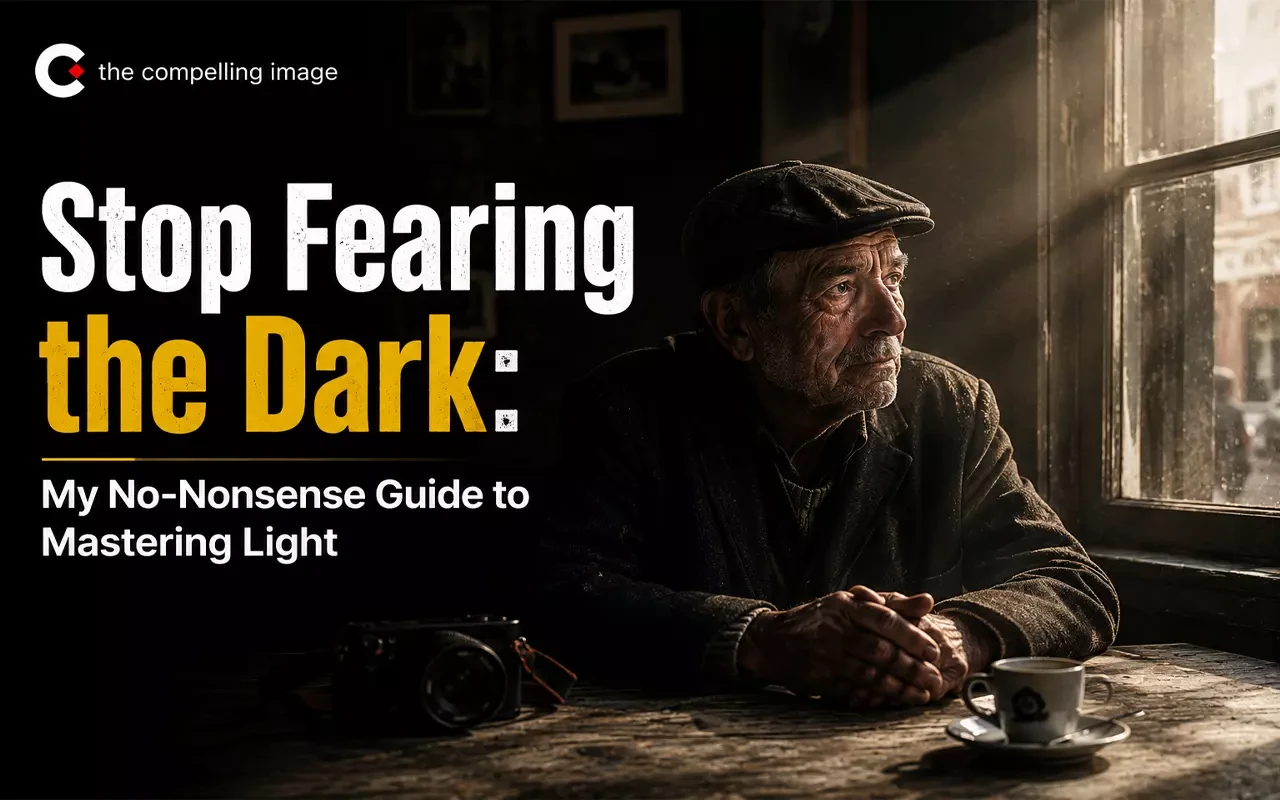
I was sitting in this hole-in-the-wall cafe in Paris about twelve years ago. It was one of those places that smelled like fifty years of burnt espresso and cheap tobacco. I had this old man sitting across from me—a local who looked like he’d seen every revolution since the 1940s. The sun was dropping fast behind the gray limestone buildings outside, and that "perfect" golden light everyone on Instagram raves about was long gone. I had my Leica on the table, and I remember looking at the shadows stretching across his face.
I could've just walked away. Found a bar, grabbed a glass of red, and grumbled about the light being dead. But that buzzing, nasty fluorescent tube above his head? That was my only shot. I had to make it work.
I see this exact same crossroad with almost every student I mentor. They come to me calling themselves "Natural Light Purists." But if I’m being blunt—and I usually am—that’s almost always a lie. It’s a crutch. It’s a fancy way of saying, "David, I’m terrified of my flash and I have no idea how to use a lamp." They think that if they touch an artificial light source, the "soul" of the photo just evaporates.
Here’s the reality I’ve learned after thirty years in the field: Light is just light. It’s just photons hitting a sensor. It doesn't matter if those photons traveled 93 million miles from a star or three feet from a $20 LED panel you bought at a hardware store. Their job is to reveal the story. If you want to move beyond being a hobbyist who only shoots on sunny Saturdays, you have to stop being afraid of the "off" switch on the sun.
The "Natural Light" Trap May Kill Your Creativity
The sun's free, yeah. But it's a liar. I've stood in the Rajasthani dust for half a day just for one sliver of light to hit a door. Then a cloud comes. Game over. If you're only out there for the 'perfect' light, you're missing the point. You're throwing away 22 hours of the day. The real stuff happens in the 2 AM jazz dives or under a heavy Mumbai sky that looks like wet cement. Stop letting the sun run your life.
Hard Light, Soft Light, and the "Big Secret"
Before you start messing with your camera dials, you have to actually see the light. This is the first thing we do in my Beyond the Click course. We stop looking at the subject and start looking at the edges of the shadows.
High-noon sun is a nightmare. It carves these ugly, black pits under the eyes. It's a portrait killer. Every pore and bead of sweat just screams at the lens. I'll take a gray, overcast sky any day. That flat, boring light? That's the real prize. It smooths everything out and makes people look human again. It's the most forgiving light I've ever used.
Here is the "Big Secret" I teach: The size of the light matters more than the brand of the light.
If your light source is small (like the sun in the sky or a tiny flash), the light will be hard. If your light source is big (like a giant window or a flash bounced off a white wall), the light will be soft. It’s physics, not magic. I’ve made "professional" portraits in a basement using nothing but a bare lightbulb and a white bedsheet held up by a student. The sheet made the light source "big," and suddenly, the light was beautiful. You don't need a $2,000 softbox; you just need to understand size.
My "Indoor Photography Tips" for the Real World
The window is your best friend, but most people use it wrong. They stand their subject right in front of it and blow out all the details.
If you’re shooting indoors, find a north-facing window. It’s the "Gold Standard" because the sun never hits it directly, so the light is soft and consistent all day. If you’re stuck with a window that has harsh sun pouring through it, don't move. Just hang a cheap, white plastic shower curtain over the glass. I’ve done this in high-end hotels and in tiny apartments in Hanoi. It turns that harsh sun into a beautiful, glowing panel.
And for heaven's sake, look at the eyes. If I don't see a "catchlight"—that little spark of reflection—the eyes look like two dead marbles. It’s a tiny detail that separates a pro from an amateur. Just turn your subject’s head a few inches toward the light until you see that spark. It’s like turning on a light inside their soul.
Why Artificial Light Isn't a "Dirty Word"
When I say "artificial light," people think of those blinding flashes at weddings that make everyone look like they’re being interrogated. That’s just bad photography.
Artificial light is everywhere. It’s the lamp on your nightstand. It’s the glowing screen of a laptop. It’s a neon sign in a rainy alleyway. In Paris, I used that flickering fluorescent bulb to highlight the man’s hands. It wasn't "pretty" light, but it was honest light.*
Lighting for beginners doesn't have to be a technical nightmare. Go to a hardware store. Buy a $15 clip-on work light. Bounce it off a piece of white foam board. Suddenly, you have a directional, soft light source that you can move anywhere. You can create a "sunset" in a closet if you want to. That’s the freedom I want for you.
The "Mixed Light" Disaster
This is where I see my students get the most frustrated. You’ve got blue light coming from a window and orange light coming from a ceiling fan. Your camera’s brain just gives up. The skin tones end up looking like a muddy, sickly mess.
I’ve spent way too many hours of my life trying to "fix" this in Photoshop. Take it from me: don't do it. It’s a losing battle.
If you’re in a room with mixed light, pick a side. Kill the overhead lights and just use the window. Or, shut the curtains and use your own lamps. Don't try to fight a war on two fronts. One color of light is your friend; two colors of light is a headache that will ruin your shot every time.
Stop Looking for Light, Start Looking for Shadows
I tell my students this every single week: stop photographing the light. Photograph the shadows.
Flat light is boring. If the light is coming from right behind you, it fills in everything. It makes your subject look like a cardboard cutout. I want you to move. Move the light or move yourself until the light is hitting the subject from the side.
Shadows are what give a photo depth. They’re what make a face look three-dimensional. They’re where the mystery lives. If you have a person standing against a wall, look at the shadow they cast. That shadow is often more interesting than the person itself.
The Bridge: Why You Can't Learn This from a Screen
I can write 2,000 words here, and you can watch 500 hours of YouTube. But you won't truly "get it" until you’re standing in a room, moving a lamp six inches to the left, and seeing how it changes the expression on a face.
Light is a language. You have to learn how to speak it. You have to notice how it "pours" through a doorway or how it "skims" across a brick wall.
This is why I don't just teach theory in Beyond the Click. I give you assignments that force you to get your hands dirty. I’ll ask you to find "Hard Light" and make it look like a piece of art. I’ll ask you to light a portrait using nothing but a flashlight.
And then—and this is the part that actually makes you a better photographer—I will look at your work.
I’ll see the mistake you didn't notice. I’ll see the shadow that’s a bit too dark or the highlight that’s a bit too bright. I’ll point it out, and I’ll tell you exactly how to fix it next time. That feedback loop is the only way to master this craft. You can't get that from a "like" on Instagram.
Let’s Master the Light Together
If you’re tired of only shooting when the weather is "good," or if you’re frustrated that your indoor photos always look like a grainy mess, I want to help you take back control.
My Beyond the Click course is a 4-week deep dive into the heart of what makes a photograph work.
- The Exposure Triangle & Light: We’ll take those settings from Blog 1 and show you how to use them to manipulate any light source.
- The "Found Light" Challenge: I’ll teach you how to see the "studio" in your own living room or on a random street corner.
- Personal Video Critiques: You’ll send me your work, and I’ll sit down and give you a real, honest critique. I’ll show you how a tiny change in position can turn a snapshot into a masterpiece.
Stop being a "Natural Light Purist" because you’re afraid. Become a "Master of Light" because you’re capable. I’ve seen hundreds of photographers make this jump, and it’s the moment their work finally starts to look like the vision in their head.
Enroll in Beyond the Click – Let’s Master the Light Together
My Final Thought: Light is the paint of our craft. If you only use the sun, you’re only using one color. When you learn to use artificial light, the whole palette opens up to you. You can create a sunset in a basement. You can create a moody noir scene in a bright office.
Don't wait for the "perfect" light. Go out and make it.
I’ll see you in the light.