On this page
By David Bathgate, Founder of The Compelling Image
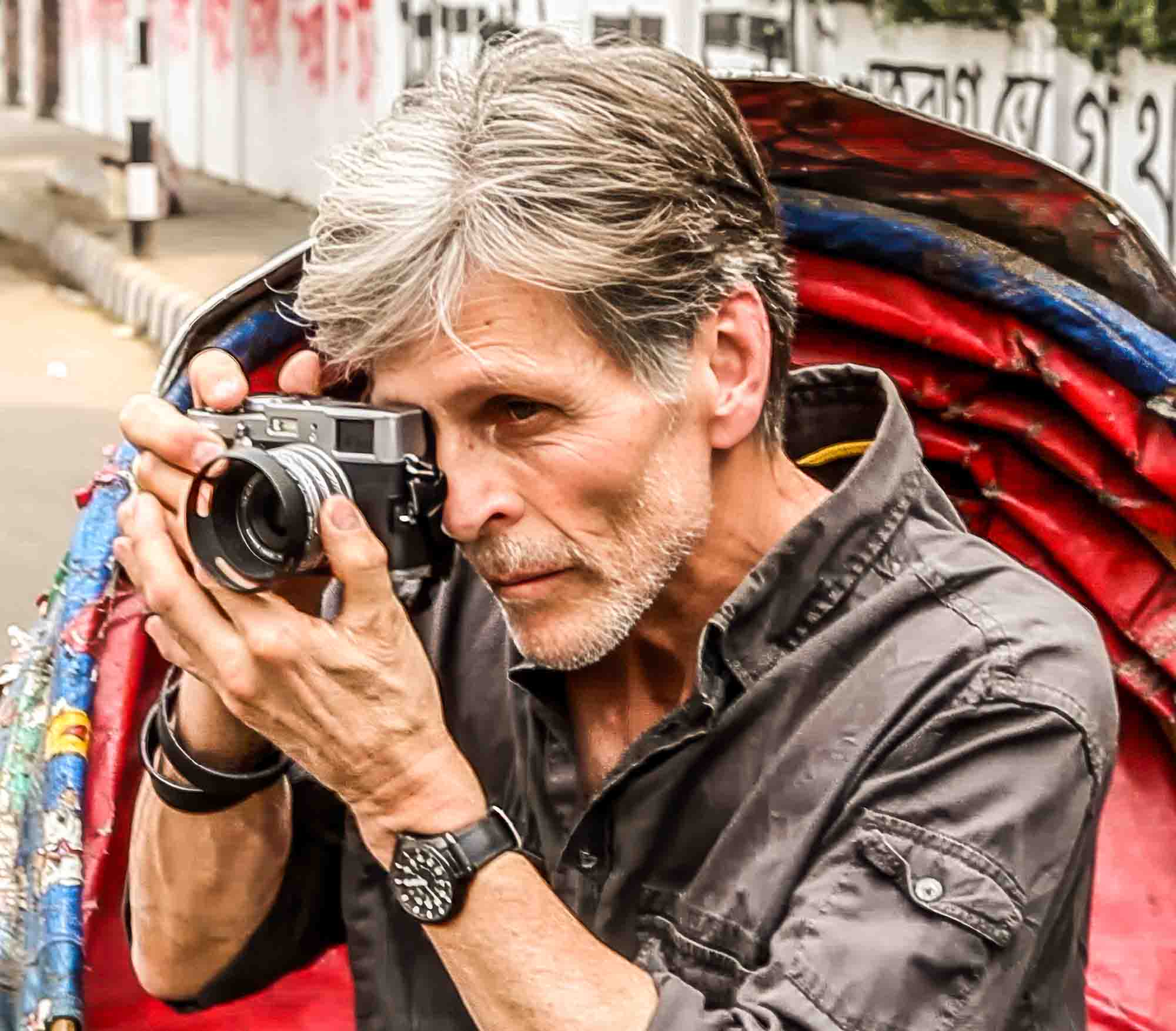
In my thirty years as a photojournalist, I’ve carried cameras through the crowded markets of Kolkata, the narrow alleys of Marrakech, and the bustling streets of New York. If there is one question I get asked more than any other by my students, it’s this: "David, what is the best gear for street photography?"
Usually, they expect me to give them a list of the most expensive, high-tech cameras on the market. They are often surprised when I tell them that in street photography, less is almost always more.
The streets are unpredictable. They are fast, chaotic, and sometimes intimate. If you are weighed down by a massive DSLR, three zoom lenses, and a heavy camera bag, you aren't a street photographer—you’re a tourist with a burden. You will miss the "decisive moment" because you were too busy fumbling with your gear.
In this 2026 guide, I’m going to strip away the marketing fluff and tell you exactly what you need to build a professional-grade street photography kit that stays out of your way.
1. The "Invisible" Camera: Choosing Your Body
When I’m looking for the best street photography camera, I’m looking for three things: speed, size, and silence.
In street photography, your goal is to be a "fly on the wall." You want to capture life as it happens, without people reacting to the presence of a "professional" camera.
- Mirrorless is King: In 2026, mirrorless cameras are the standard. They are smaller, lighter, and—most importantly—they have silent electronic shutters. I often shoot just inches away from people; if they hear a loud clack-clack of a mirror, the moment is gone.
- The Sensor Size Debate: You don't need a full-frame sensor for the street. In fact, many of my favorite street photographers (and myself included) often prefer APS-C or even Micro Four Thirds systems. Why? Because the cameras and lenses are smaller, they allow you to blend into the crowd.
- Fixed Lens vs. Interchangeable: Cameras like the Fujifilm X100 series or the Ricoh GR III are legendary in the street community. They have a fixed lens, which forces you to stop worrying about "zooming" and start moving your feet.
My Advice: Choose a camera that feels like an extension of your hand. If it’s too complicated to use without looking at the buttons, it’s the wrong camera for the street.
2. The "Storyteller" Lenses: Prime vs. Zoom
If you look into my bag, you won't find many zoom lenses. For street work, I am a firm believer in Prime Lenses (fixed focal lengths).
Why? A prime lens teaches you to "see" in a specific focal length. After a few days of shooting with a 35mm lens, you will know exactly where to stand to frame a shot before you even lift the camera to your eye.
- The 35mm (The Classic): This is the "Gold Standard." It’s wide enough to show the environment but tight enough to feel intimate. It’s what I use for 80% of my street work.
- The 50mm (The Nifty Fifty): This is closer to how the human eye sees. It’s great for street portraits where you want a bit more separation between your subject and the background.
- The 28mm (The Wide Perspective): If you want to get "in the thick of it," like the legendary Bruce Gilden or Garry Winogrand, this is your lens. It requires courage because you have to get physically close to people.
My Pro Tip: Avoid big, heavy f/1.2 lenses. A small f/2 or f/2.8 prime is lighter, cheaper, and much more discreet. In street photography, "discreet" is your most valuable asset.
3. Beginner Street Gear: Starting on a Budget
I know that gear is expensive. If you are just starting out, don't feel like you need to spend $5,000 to be a "real" photographer.
The best beginner street photo gear is often the gear you already own. Even a high-end smartphone can be a powerful street tool because everyone has a phone—no one suspects you are making art with it.
If you are looking to buy your first "real" street setup, look for used older models of the Fujifilm X-E series or the Sony a6000 series. Pair it with a 27mm or 35mm "pancake" lens, and you have a powerhouse kit that fits in a jacket pocket.
4. The Accessories You Actually Need
In the street, every extra ounce of weight is an enemy. However, there are three accessories I never leave home without:
- A Comfortable Wrist Strap: I rarely use neck straps. They scream, "I have a camera!" A wrist strap allows me to let the camera dangle by my side, hidden by my palm, until the moment I need it.
- Extra Batteries: Mirrorless cameras eat batteries. I always carry at least three. Nothing is more frustrating than seeing the perfect shot and realizing your camera is a paperweight.
- Fast Memory Cards: You don't want your camera "buffering" while a street performer is doing something incredible. Get a card with a high write speed.
What you DON'T need: A tripod. A flash (unless you are going for a very specific, aggressive style). A giant camera bag. I prefer a small, nondescript messenger bag or even just a sturdy pair of cargo pants.
5. The "Gear Trap": Why Your Camera Isn't the Problem
I’ve seen students show up to my workshops with the latest $6,000 Leica, yet they are terrified to point it at a stranger.
This is the Gear Trap. We tell ourselves that if we just had a better lens or a faster autofocus system, our photos would be better. It’s a lie we tell ourselves to avoid the hard work of being brave.
The most important "gear" in street photography isn't made of glass and magnesium. It’s your eyes, your feet, and your courage.
- Your Eyes: Learning to anticipate a moment before it happens.
- Your Feet: Learning how to position yourself without interrupting the scene.
- Your Courage: Learning how to overcome the fear of being noticed.
6. The Bridge: From Gear to Craft
You can buy the perfect street photography camera today, but it won't teach you how to tell a story. It won't teach you how to use light to create mystery or how to compose a chaotic scene into a beautiful image.
This is why I created my Fearless Faces course.
Most street photography "tutorials" focus on the technical settings. In my course, I focus on psychology and art. I want to help you move past the gear and start seeing the world through the lens of a storyteller.
7. Master the Street with Me: Fearless Faces
If you’ve ever felt that "paralysis" on the street—where you see a great shot but can't bring yourself to take it—Fearless Faces is for you.
This is an intensive, interactive workshop where I don't just give you "tips." I give you assignments designed to build your confidence and your portfolio.
- Overcoming the Fear: I’ll teach you my personal techniques for approaching strangers and shooting candidly without causing conflict.
- Personalized Critiques: This is the core of what I do. You submit your street photos, and I sit down and provide a detailed video critique. I’ll show you exactly how to crop, edit, and improve your timing.
- A Community of Explorers: You’ll join a group of like-minded photographers from around the world, sharing their "wins" and their challenges on the street.
Don't let your gear sit in a bag. Let's go out and use it.
Enroll in Fearless Faces – Master the Art of Street Photography with Me
My Final Thought: The best gear for street photography is the gear that makes you want to go outside. If your camera is too heavy, you’ll leave it at home. If it’s too expensive, you’ll be too afraid to take it into the rain. Find a kit that is simple, reliable, and small—then forget about the gear and start looking for the light.
I’ll see you on the street.