On this page
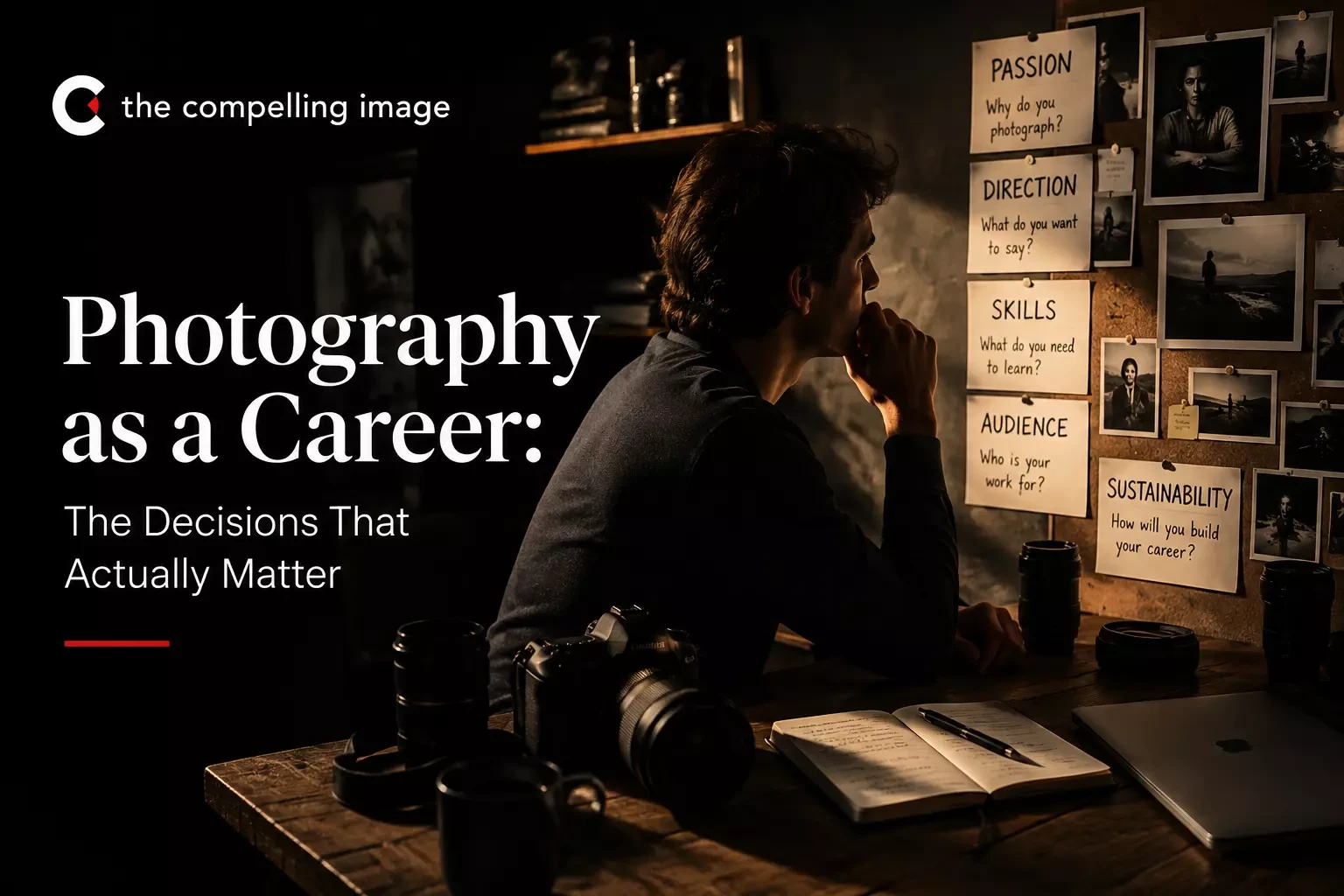
Most advice about starting a photography career falls into one of two camps. Either it's relentlessly optimistic — follow your passion, the work will come — or it's discouraging in a way that masquerades as realism. Neither is particularly useful.
What follows is neither. It's a set of decisions you will have to make — some early, some later — and a clear account of what's actually at stake in each of them.
Decision One: What Kind of Photographer Do You Want to Be?
This sounds like a soft question. It isn't. The answer determines almost everything else — what you should be learning, whose work you should be studying, what kind of clients you'll need, and what kind of life the career will produce.
Broadly, photography careers fall into two categories: assignment work and personal work. Assignment photographers are hired to produce specific images for clients — advertising agencies, editorial publications, corporate communications, wedding couples. Personal work photographers — documentary photographers, fine art practitioners, photojournalists — build a body of work driven by their own vision and find ways to fund it.
Most working photographers do both, in different proportions. But which side pulls you more strongly? Assignment work is more financially stable and less personally driven. Personal work is more financially precarious and more creatively demanding.
There is no right answer. But there is a wrong answer: not thinking about it and ending up building the wrong kind of career for the wrong reasons.
Decision Two: Which Genre Will You Go Deep In First?
Photography covers enormous ground. Portrait, landscape, street, documentary, architectural, product, food, fashion, wildlife, scientific. Each has its own technical demands, its own market, its own visual language.
Go deep in one area before you try to cover several. A photographer known for serious Travel Photography work builds a reputation that a generalist doesn't. A photographer who has spent two years shooting only landscape Photography understands light, weather, and long exposure in ways that someone who photographs landscapes occasionally doesn't. Specialism is not a limitation — it is a credential.
Choose based on what holds your attention most reliably — not what seems most commercially promising right now. Markets shift. Your attention doesn't lie.
Decision Three: How Will You Actually Get Better?
This question has a more specific answer than most people expect.
You get better by shooting — but only if you shoot with intention, review your work critically, and make adjustments based on what you find. Shooting without review is just accumulating files.
You get better faster when someone with more experience looks at your work and tells you what they see. Not what you intended — what is actually there in the image. That gap between intention and result is where almost all the development happens.
You also get better by understanding light properly — not just exposure settings, but the quality, direction, and color of light, and how to work with what's available. Knowing Low-light Photography, for example, is not just a technical skill — it opens up entire categories of situations that most photographers avoid.
What does not make you better: buying more gear, watching more tutorial videos without applying what you watch, and comparing your early work to the finished work of photographers with twenty years of experience.
Decision Four: What Does Your Portfolio Actually Need to Say?
A portfolio is not a best-of collection. It is an argument about what you can do consistently.
The most common portfolio mistake photographers make is including too much — every genre they've tried, every technically successful image, every piece of work they're personally attached to. A portfolio that says everything says nothing.
A strong portfolio answers a specific question for a specific kind of client or viewer: can this photographer deliver what I need, at the level I need it? Everything in the portfolio should serve that answer. Anything that doesn't should be removed, regardless of how much you like it.
Building toward a strong portfolio means committing to photography projects rather than random shooting. A coherent project produces a series of images that show how you think, not just what you can technically execute.
Decision Five: Where Do You Find the Right Training?
Photography education ranges from excellent to actively misleading. The most important thing to understand is that not all learning formats produce the same result.
Passive consumption — watching videos, reading articles — transfers information. It does not develop judgment. Judgment develops through making photographs, having them reviewed by someone who knows what they're looking at, and then making more photographs with that feedback integrated.
When evaluating any course or program, ask one question first: will my actual photographs be reviewed by the instructor? If yes, find out how — in what detail, with what regularity. If no, the format may be useful for technical information, but it will not develop your eye.
Also look at who is teaching. The instructor's own body of work tells you more than their credentials. Someone who has built a serious career as a professional photographer teaches differently from someone who has primarily taught. Both have value, but they are different kinds of value.
What The Compelling Image Is Built For
The courses here are structured around assignments, feedback, and sustained practice rather than passive instruction. The instructors are working photographers — people who are still making images, still solving the problems you're trying to solve.
The emphasis is on visual storytelling and coherent work rather than technical perfection. Technical skills matter and are taught — but they are taught in service of making photographs that communicate something, not photographs that merely demonstrate competence.
If you're looking for the right photography courses to build a serious foundation — not just technical skills, but a genuine photographic voice — this is what the program is designed for.
Photography is a long game. The decisions you make in the first two years — about what to learn, how to learn it, what kind of work to build — shape everything that comes after. Make them deliberately.